
Type A and type AC refer to two categories of residual current devices that do not detect the same forms of leakage current. The choice between the two directly depends on the nature of the devices connected to the circuit, and the NF C 15-100 standard increasingly favors type A for a growing part of the installation. Understanding what each letter technically covers helps avoid an improperly sized or non-compliant electrical panel.
Leakage currents detected: type A vs type AC in a comparative table
The fundamental distinction between these two types of residual current devices lies in the form of the residual current they are capable of identifying. Type AC only reacts to pure sinusoidal leaks, that is, to classic alternating current. Type A covers the same spectrum but adds the detection of pulsating leakage currents with a direct current component, generated by circuits containing power electronics.
| Characteristic | Type AC | Type A |
|---|---|---|
| Sinusoidal currents (pure alternating) | Yes | Yes |
| Rectified pulsating currents | No | Yes |
| Smooth direct current component | No | No (type B required) |
| Symbol on the casing | Only sinusoidal wave | Sinusoidal wave + rectified wave |
| Mandatory residential circuits (NF C 15-100) | Lighting, standard outlets, roller shutters | Cooking plates, washing machines, EV charging stations, heat pumps |
To delve deeper into the difference between type A and type AC circuit breakers and its implications on panel sizing, cross-referencing the UTE C 15-600 application guides remains the most reliable technical reference.
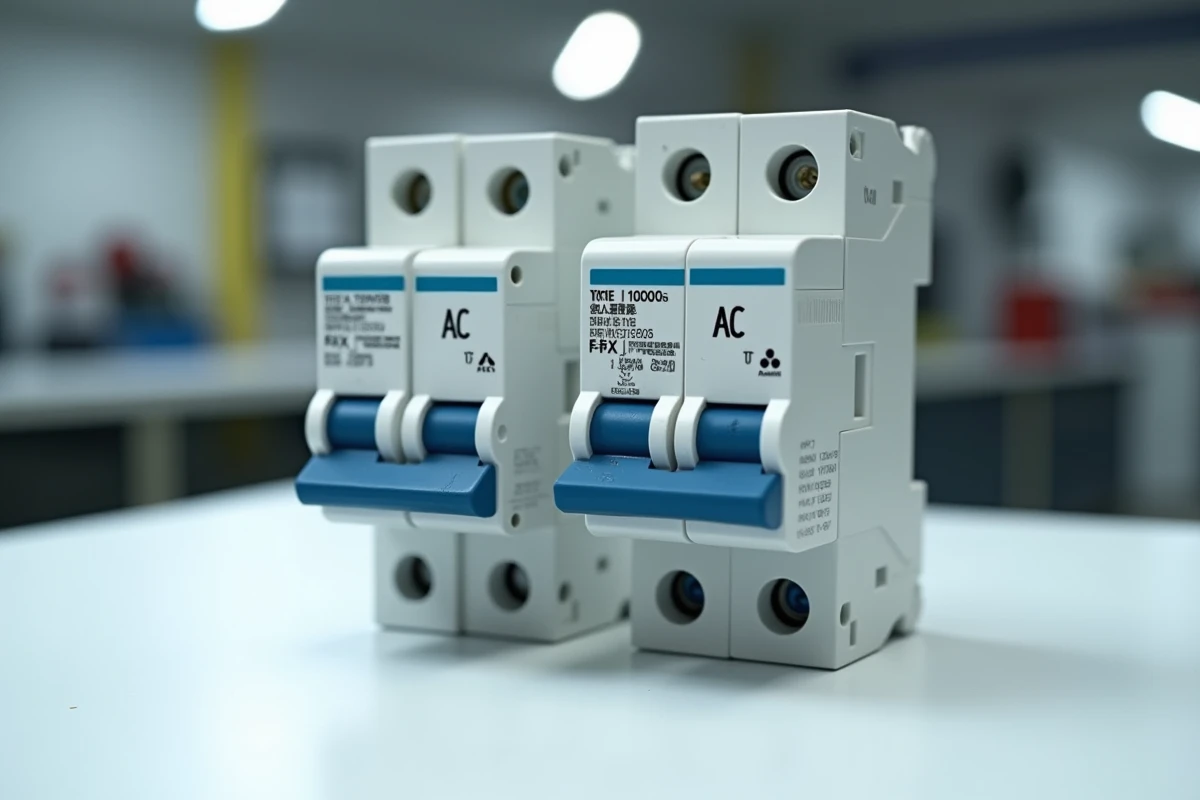
Residential circuits under type A: the list is growing with the NF C 15-100 standard
The NF C 15-100 standard mandates type A for any circuit supplying a device likely to produce non-sinusoidal residual currents. Historically, this obligation applied to induction cooktops and washing machines. Recent revisions have broadened the scope.
The following are now included:
- The circuits for cooking plates (induction or ceramic), which rectify the current via their control electronics.
- The washing machine, whose motor speed controller generates pulsating currents.
- Charging stations for electric vehicles, including reinforced sockets in mode 2, which integrate a rectifier.
- Some electronic power supplies for boilers and heat pumps, whose power circuit produces partial leakage with a direct current component.
Type AC remains permitted for lighting circuits, standard power outlets, roller shutters, or electric heating with pilot wire without power electronics. However, a type AC placed on a pulsating component circuit may never trigger in case of a leak, rendering the protection inoperative without a visible signal for the occupant.
Distribution in the electrical panel: sizing rules by row
The NF C 15-100 standard requires at least one type A residual current device per panel, but the practice recommended by manufacturers like Schneider Electric or Legrand goes further. Each row of the panel groups circuits protected by the same residual current device, and the distribution must balance the loads between the rows.
A standard dwelling typically has two to four residual current devices. Type A protects the row grouping the “sensitive” circuits (kitchen, laundry, EV charging station). The remaining rows, allocated to standard outlets and lighting, can be under type AC.
Common mistake: putting everything under type A as a precaution
Replacing all residual current devices with type A poses no technical protection issues. Type A detects everything that type AC detects, plus pulsating currents. The unit cost increase is moderate. The reason installations do not fully switch to type A lies in the cost/benefit ratio: on a standard LED lighting circuit, the risk of pulsating leakage is almost zero, and type AC fulfills its function perfectly.
Conversely, undersizing the protection by placing a type AC on an induction cooktop circuit constitutes a detectable non-compliance during the electrical diagnosis, with an obligation to bring it into compliance before sale or rental.

Type F and type B: when type A is no longer sufficient
Type A covers the majority of residential needs, but some equipment generates leakage currents that even type A cannot detect. Frequency converters, photovoltaic inverters, and certain fast charging stations produce smoothed direct current components that require a type B residual current device, capable of detecting all forms of residual current.
Type F, sometimes referred to as “super immunized” type A, offers increased sensitivity to high frequencies generated by switch-mode power supplies. It positions itself between type A and type B in terms of detected spectrum and price.
For a residential installation without a fast charging station or photovoltaic inverter, the combination of type A and type AC remains sufficient according to the standard. The addition of a type F or B only becomes relevant when the installation includes advanced electronic power conversion equipment.
The choice between type A and type AC boils down to a technical question: does the circuit supply a power electronics device? If so, type A is mandated by the standard. If not, type AC adequately protects people against sinusoidal leaks. Recent developments in the NF C 15-100 push for an increased presence of type A in new panels, reflecting the direct increase in electronic devices in homes.