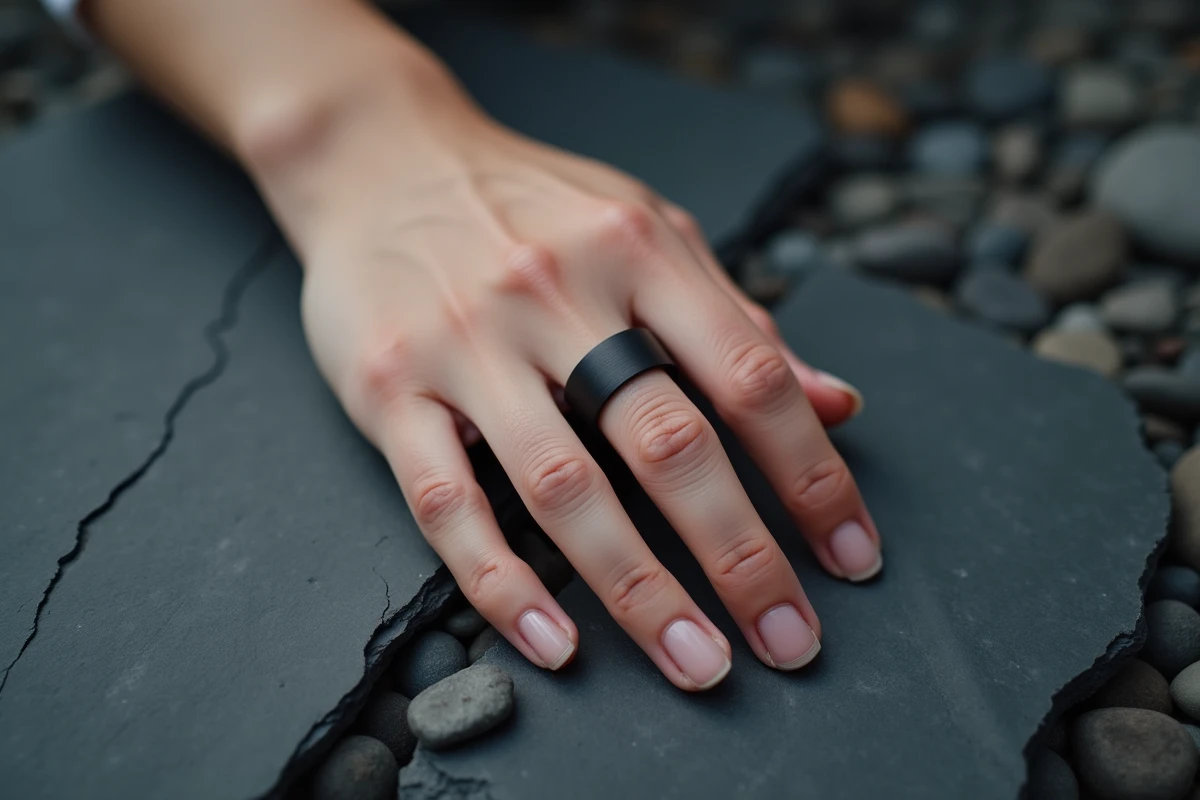
The black ring holds a unique place in the world of jewelry. Neither a classic wedding band nor a simple fashion accessory, it conveys codes that vary according to the material, the chosen finger, and the cultural context. Understanding these codes allows one to measure the gap between what the wearer expresses and what those around them perceive.
Materials of black rings: comparative properties
The choice of material alters both the visual effect and the symbolic message. A black tungsten ring does not send the same signal as a silicone or onyx band. The table below summarizes the main options available on the market.
| Material | Appearance | Scratch Resistance | Symbolic Connotation |
|---|---|---|---|
| Black tungsten | Shiny, heavy | Very high | Power, modernity |
| Black titanium | Matte, light | High | Sobriety, technicality |
| Onyx | Shiny, mineral | Moderate | Protection, historical grounding |
| Black silicone | Matte, flexible | Low (deformable) | Practicality, active lifestyle |
| Black Damascus steel | Wavy patterns | High | Craftsmanship, uniqueness |
| Black diamond | Faceted, deep | Very high | Discreet prestige, rarity |
Tungsten and titanium dominate the segment of men’s black wedding bands. Their scratch resistance makes them suitable for manual labor, where a gold ring would quickly show signs of wear.
To delve deeper into the meaning of black rings according to materials and uses, the nuances between historical onyx and contemporary tungsten deserve particular attention.
Onyx and black diamond, used since Greek and Roman antiquity, carry an older symbolic weight. Onyx was associated with protection and power in several Mediterranean civilizations. The rarer black diamond has retained an aura of prestige that industrial tungsten lacks.
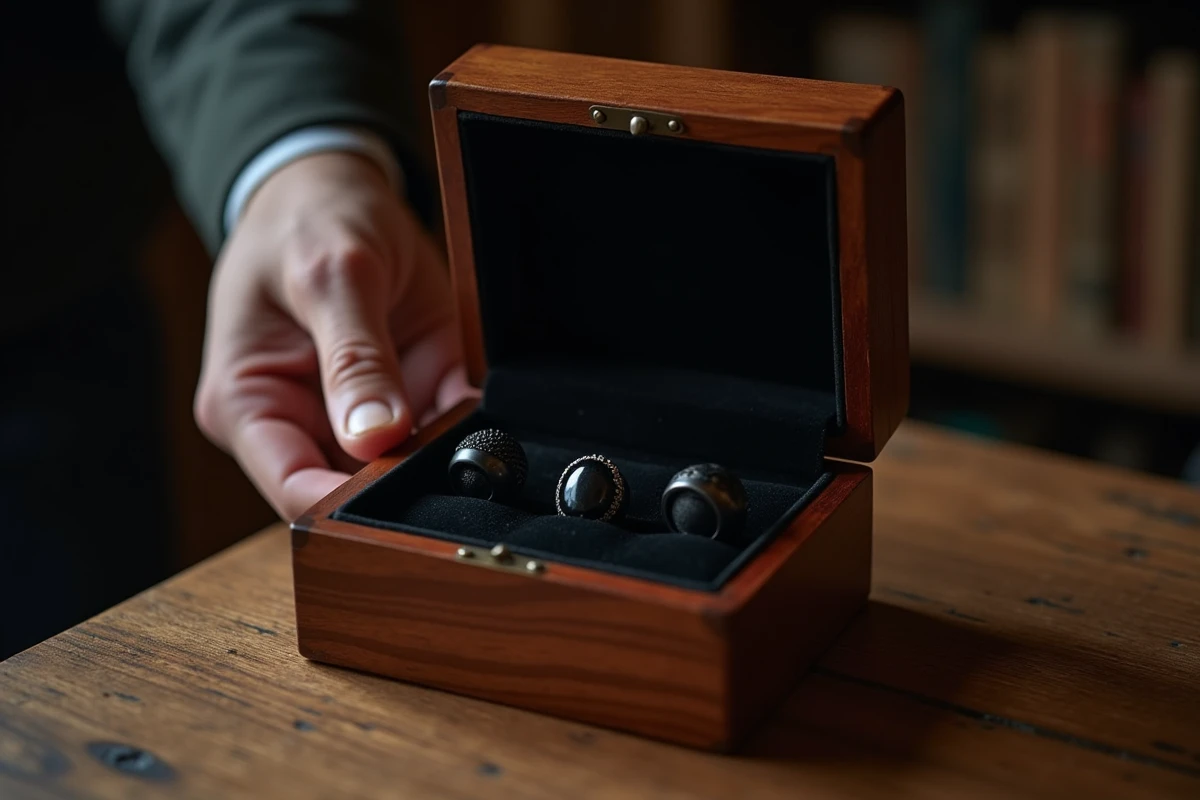
Black ring and finger code: how placement changes meaning
The symbolism of a black ring is not limited to its color or material. The finger on which it is worn radically alters its interpretation.
- Left ring finger: traditional placement for a wedding band. A black ring worn here signals a committed marital engagement, often breaking away from golden or silver conventions.
- Index finger: historically linked to authority and command. A black ring on the index finger reinforces a message of discreet leadership.
- Pinky finger: this finger refers to independence and social status. In some Asian cultures, it is associated with luck. It is also a placement that avoids any confusion with a wedding band.
- Thumb: less common in Europe, the thumb carries connotations of will and personal assertion.
The right hand rather than the left adds an additional layer of interpretation. In several traditions, the right hand is associated with action, while the left is associated with reception. Wearing a black ring on the right hand suggests a voluntary approach rather than a received commitment.
Community symbol and identity codes of the black ring
Fashion articles often approach the black ring from an aesthetic angle. They frequently overlook a usage that has developed online: the black ring as an identity marker within specific communities.
In certain LGBTQ+ circles, a black ring worn on the right ring finger functions as a sign of recognition. Discussions on forums like Reddit show that this piece of jewelry can indicate an orientation towards polyamory or signal belonging to queer codes. The black ring then acts as a silent language among insiders, far from its mainstream interpretation.
This phenomenon is not new in the history of jewelry. Rings and bands have often served as discreet codes, from Masonic signet rings to Victorian mourning bands. The color black, due to its ambiguity, lends itself particularly well to these uses: it can be read as a purely aesthetic choice by those who do not know the code, and as a clear signal by those who share it.

Elegance and quiet power: why black dominates
Black has traveled a particular cultural path. Long reserved for mourning and clergy, it has evolved over the centuries into a marker of prestige and then of assumed sobriety. This evolution explains why the black ring can be perceived simultaneously as discreet and authoritative.
In contrast, a yellow gold or platinum ring falls within a visible tradition. Gold announces, black suggests. This difference in tone attracts profiles that prefer elegance without ostentation.
The success of the black ring in wedding bands illustrates this trend. Couples choose black not out of rejection of conventions, but because black conveys a commitment without the need for external validation. The material (tungsten, titanium) reinforces this interpretation: it evokes solidity without ostentation.
Black ring and professional context
In manual professions, a black silicone or tungsten ring meets a practical constraint. Silicone breaks under high pressure rather than injuring the finger, making it a safety choice. Tungsten withstands shocks and common chemicals. The symbolic dimension and the functional dimension converge in these contexts.
For creative or technological professions, the black ring functions as a complete dress code. It aligns with a minimalist wardrobe and reinforces an image of rigor without excessive formality.
The black ring remains a piece of jewelry whose interpretation depends as much on the context as on the wearer. Material, finger, hand, community of belonging: each variable shifts the meaning. An onyx ring on the left pinky and a tungsten wedding band on the right ring finger do not tell the same story, even if their color is identical.