
When a historic factory like Mirafiori in Turin operates at reduced capacity for weeks due to a line conversion to electric, it becomes clear what it means to manage a group the size of Stellantis. The manufacturer, born from the merger between PSA and FCA in January 2021, manages a portfolio of fourteen brands, dozens of industrial sites, and a technological transition that affects every workstation.
Local battery quota in Europe: the regulatory constraint that changes the game for Stellantis
The European Union adopted Regulation (EU) 2025/2847 on critical materials in December 2025. This text imposes a 40% quota for locally produced batteries by 2028 on car manufacturers, including Stellantis. On the ground, this means that the planned gigafactories in Termoli (Italy) and Douvrin (France) are no longer just an industrial project, but a regulatory obligation.
For a group that still largely sources Asian cells, the timeline is tight. Building a battery production line takes between two and three years at best. It is clear why Stellantis’s logistics teams must rethink their supply chains in parallel, without interrupting the production of thermal models that finance the transition.
To better understand the exact scope of the group and its subsidiaries, one can consult the detailed sheet about Stellantis on Wiki FR, which outlines the capital structure resulting from the PSA-FCA merger.
Social tensions in Stellantis factories: what the electric conversion causes daily
Since mid-2025, strikes have multiplied at Stellantis sites in Italy and France. The social report for 2025 published by the CGT Stellantis in January 2026 documents a significant upward trend in social conflicts, directly linked to the transition to electric.
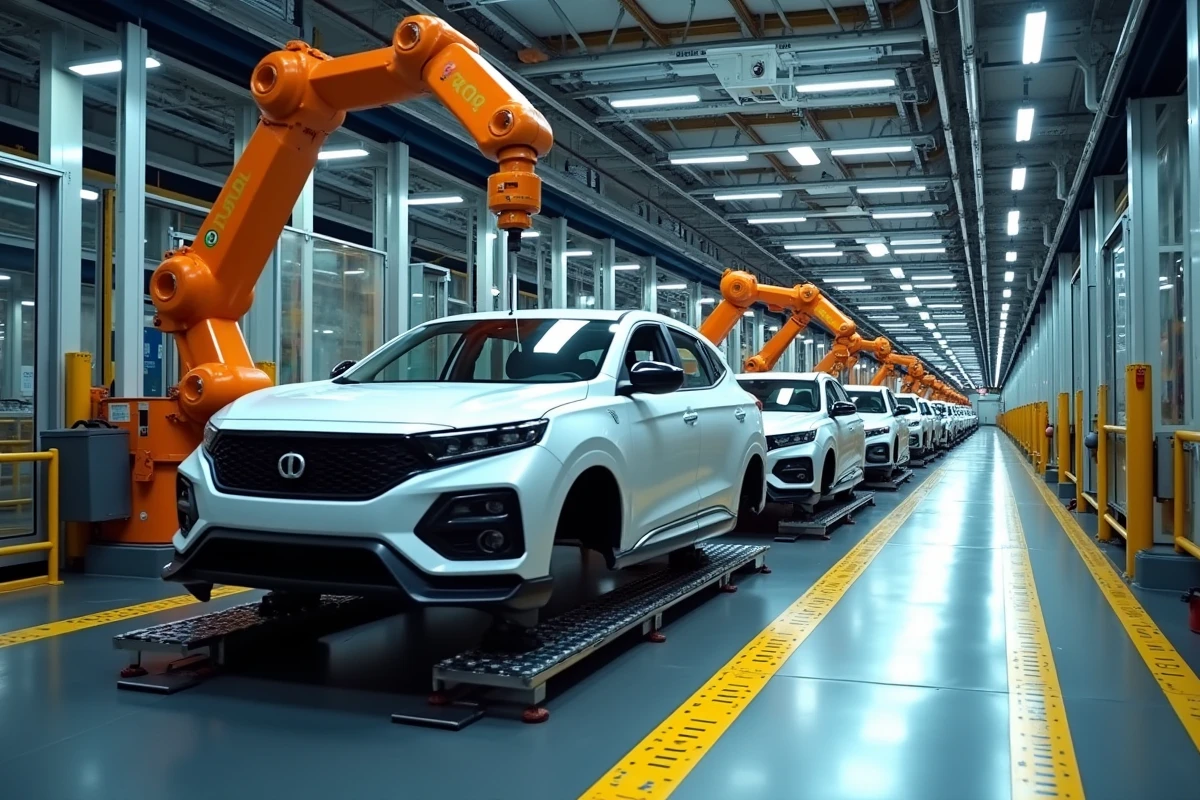
Specifically, converting an assembly line from thermal engines to electric powertrains eliminates certain jobs (machining engine blocks, assembling gearboxes) and creates others (battery pack assembly, high-voltage wiring). The gap between existing skills and new needs generates uncertainty for employees.
Feedback varies on this point depending on the sites: in Sochaux, internal training has allowed for the redeployment of part of the workforce, while in Mirafiori, the use of extended partial unemployment fuels tension. The social management of this transition is as crucial as the technology itself for the group’s competitiveness.
Stellantis-Leapmotor partnership: field feedback on low-cost electric vehicles
Stellantis has bet on a partnership with the Chinese manufacturer Leapmotor to offer low-priced electric vehicles, particularly in North America. The J.D. Power “2026 North America EV Experience Study,” published in April 2026 and conducted with five hundred early adopters, delivers mixed results.
Recurring complaints focus on the quality of interior finishes. In a segment where the entry price is the main argument, finish defects undermine the vehicle’s commercial promise. A customer buying an affordable electric car tolerates simplified equipment, but not rough assemblies.
For Stellantis, the risks are twofold:
- A negative return on Leapmotor models distributed under license could tarnish the image of the group’s historic brands (Peugeot, Citroën, Fiat) by association.
- Competing Chinese manufacturers like BYD or MG are quickly improving their perceived quality, reducing the price advantage window for Leapmotor.
- The quality control exercised by Stellantis on a product designed in China is structurally more difficult than on a vehicle developed in-house.
The group’s multi-energy strategy, which includes hydrogen, electric, and hybrid powertrains, is based on the idea that each brand targets a specific segment. The credibility of this architecture depends on the actual quality perceived by end customers, not just on marketing positioning.

Level 4 autonomous driving: Stellantis’s structural delay compared to American competition
The comparative analysis published by IIHS (Insurance Institute for Highway Safety) in March 2026 highlights a clear gap. Stellantis focuses its level 4 autonomous driving tests in Europe, with a limited geographical and regulatory scope. Meanwhile, Waymo and Tesla are deploying massively in the United States.
This asymmetry is not only technological. The European regulatory environment imposes longer validations, and Stellantis does not have a fleet of robotaxis comparable to Waymo’s to accumulate real-world driving data. The volume of field data directly conditions the speed of algorithm progression.
For a group that primarily produces vehicles for the general public, level 4 autonomous driving is not an immediate commercial priority. However, the delay accumulated today could weigh heavily when this technology reaches the commercial vehicle and shared mobility segments, two markets where Stellantis is very present with Ram, Fiat Professional, or Free2Move.
Stellantis’s multi-brand strategy: balancing heritage and profitability
Managing fourteen automotive brands requires making ongoing resource allocation choices. Every euro invested in renewing the Lancia range is a euro not spent on Chrysler or DS. The question is not whether some brands will survive, but which ones will receive the necessary investments to remain competitive in their respective markets.
The concrete arbitration criteria boil down to a few indicators:
- The operating margin per vehicle sold, which varies significantly between Maserati and Citroën.
- The natural geographical coverage of each brand (Jeep in the United States, Peugeot in Europe and Africa, Fiat in Latin America).
- The ability of each brand to absorb the additional costs associated with electrification without destroying its price positioning.
The global automotive industry observes Stellantis as a real-world test of the viability of the multi-brand model in the era of energy transition. The coming years will reveal whether the group’s critical mass constitutes a decisive advantage or a structural burden against more agile competitors.