
The Quimper earthenware market is full of pieces stamped Henriot, but not all deserve the same attention. Since the early 2020s, Breton auctioneers have noted a decline in demand for the common productions from the second half of the 20th century, while Art Deco pieces from the 1920s-1930s remain sought after. This disparity in value makes dating an old Henriot earthenware piece all the more crucial for anyone buying, selling, or inheriting a piece.
Fake Quimper and industrial copies: the pitfalls of the online market
Before even attempting to date a piece, the first step is to verify that it is indeed an authentic Henriot production. Experts report a growing frequency of confusion between Henriot earthenware and foreign or industrial “Quimper style” productions, especially on resale platforms.
Three clues can quickly rule out a copy. First, the paste: a tin-glazed earthenware from Quimper has a slightly creamy hue, sometimes irregular. An overly cold and uniform whiteness often betrays a recent industrial production.
Next, the decoration: on an authentic hand-painted piece, the layer of paint forms a slight relief that is perceptible to the touch. A perfectly smooth and even decoration indicates the use of transfers. The absence of a stamp or mark on the back remains the most reliable warning sign, as the vast majority of Henriot pieces bear an identifiable inscription.
To date an old Henriot earthenware piece, one must first ensure they are holding a piece that came from the Locmaria workshops, and not an imitation produced outside Brittany.
Marks on the back and signatures: what the Henriot stamp reveals about dating
The back of a Henriot earthenware piece serves as its main identity document. The marks applied under the piece have evolved over the decades, and it is this evolution that forms the most reliable dating method.
- Pieces made before 1922 generally bear simple marks, often the initials “HB” (for the historical manufacture). The writing is sometimes handwritten, irregular, and traced in the glaze before firing.
- Between 1922 and 1968, the full name “Henriot Quimper” appears more systematically, sometimes accompanied by the model number or a decor code. This is the most documented period.
- After 1968, the marks modernize with more standardized stamps, sometimes accompanied by numerical codes that facilitate identification but also indicate pieces of lesser interest to collectors.
The signature of the decorative artist, when it exists, provides a second level of information. Names like Sévellec or Méheut refer to artistic collaborations from the 1920s-1930s, an Art Deco period that currently concentrates the bulk of demand in the auction market.
Limits of reading stamps
Field reports vary on this point: some pieces exhibit ambiguous marks, re-stamped or partially erased by use. A stamp alone is not always sufficient to date a piece accurately. This information must be cross-referenced with other material clues.
Glaze, decoration, and paste: the physical criteria that refine dating
Beyond the stamp, the piece itself provides clues that specialists systematically exploit.
The tin glaze of old productions has a slightly grainy appearance, with fine crazing (craquelure) that indicates natural aging. A perfectly smooth and shiny glaze points to a more recent production or a reissued piece.
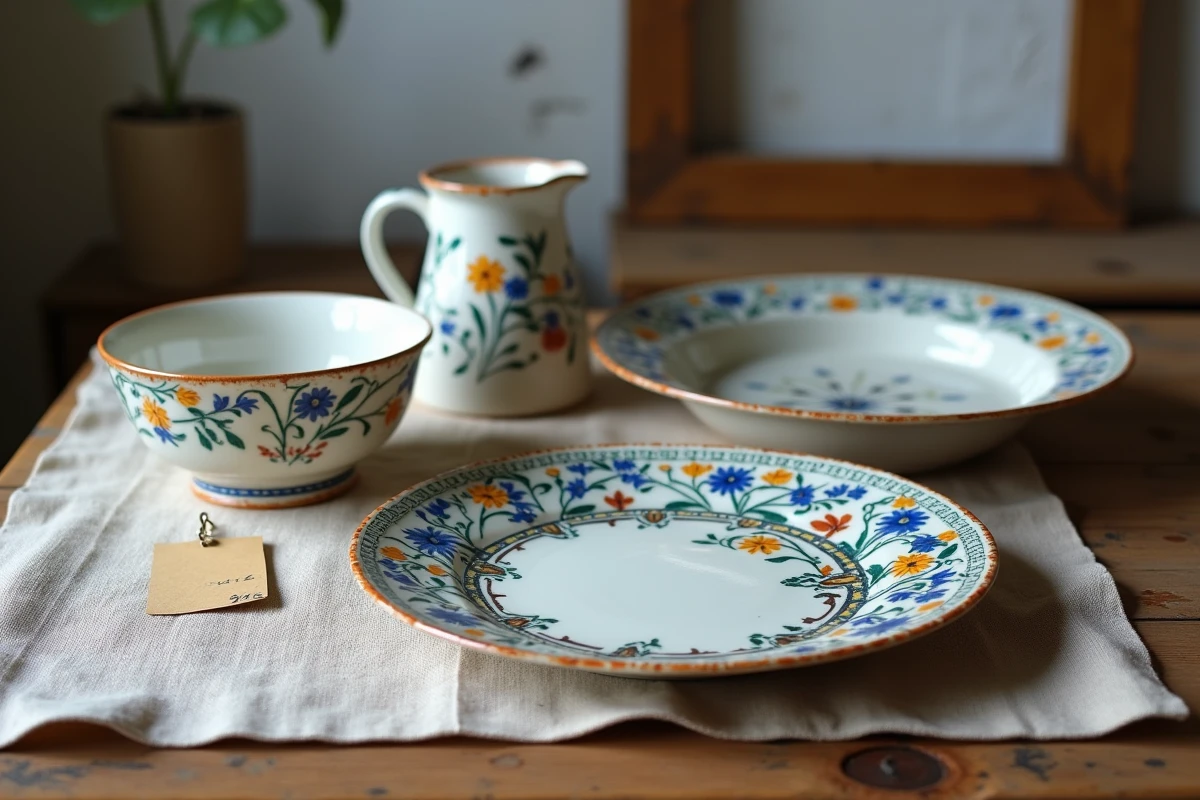
The painted decoration also provides information about the era. The motifs of the Petit Breton in traditional costume, treated with a certain naivety of line, characterize productions from the 19th century and early 20th century. Geometric or stylized decorations indicate the Art Deco period. Pieces made after the 1960s tend to feature more simplified, sometimes repetitive motifs.
The color of the paste visible under the glaze (in worn areas or at the foot) also varies. A light chamois paste will suggest an older production, while a very white paste suggests a later manufacture, with different raw materials.

Getting a Henriot earthenware piece appraised: the real journey of individuals
Henriot-Quimper has officially stated that it no longer conducts value appraisals or issues certificates for its old productions. The manufacture systematically redirects requests to specialized studies. This positioning forces individuals to take other paths.
Specialized Breton auctioneers (studies based in Quimper or Brest) remain the most competent contacts for a reasoned dating. Their free estimates during appraisal days allow for a professional opinion without commitment. Regional auctions regularly dedicate entire sessions to Quimper earthenware.
What really influences value
Dating alone does not determine the price. The condition (chips, cracks, restorations), the rarity of the model, and especially the signature of a recognized artist from the Art Deco period weigh more heavily than mere age. A 19th-century piece in poor condition will often be worth less than a plate signed Méheut from the 1930s in good condition.
The current market for Henriot earthenware reflects a reality that mere dating does not summarize. Common post-war pieces find it hard to attract buyers, while signed Art Deco productions retain their appeal. Knowing how to date a piece also means knowing which segment of the market it belongs to, and adjusting expectations accordingly.